


Expensive tooling, lead times of several months, never-ending fine-tuning... these are the obstacles many teams fear when they think about product industrialization. But this stage isn't reserved for large companies: it can be prepared smartly to stay agile, fast and cost-effective.
For small and medium technical batches (10 to 500 units) — wearables, wearable airbags, medical devices — industrialization follows different rules than high volumes: less heavy tooling, more in-house pre-series, selective partnerships. Here is our practical advice to reduce industrialization cost and optimise your lead times.
1. Calibrate your strategy: every project has its own stakes
Defining clear objectives and a suitable production strategy is the first step of successful industrialization.
Three typical cases:
- Consumer wearable (connected sportswear): medium-series production (5k-50k/year), priority on productivity + validated washability. Moderate tooling investment.
- Certified medical device: small batches (10-500/year), priority on traceability + MDR file + ISO 13485. Significant documentation investment.
- B2B airbag PPE: medium series (1k-10k/year), priority on reliability + CE PPE certification. Mix of soft tooling (sewing, HF welding) and industrial components.
These approaches show that there is no single industrialization strategy. The choice depends on product maturity, market, target volume and certifications.
+ AQ-TIPS
- Every product calls for its own industrialization strategy.
- Carefully assess your sales forecast (volume x price x margin).
- Identify critical parts and functions.
- The product will always evolve — plan for flexibility.
2. The right timing
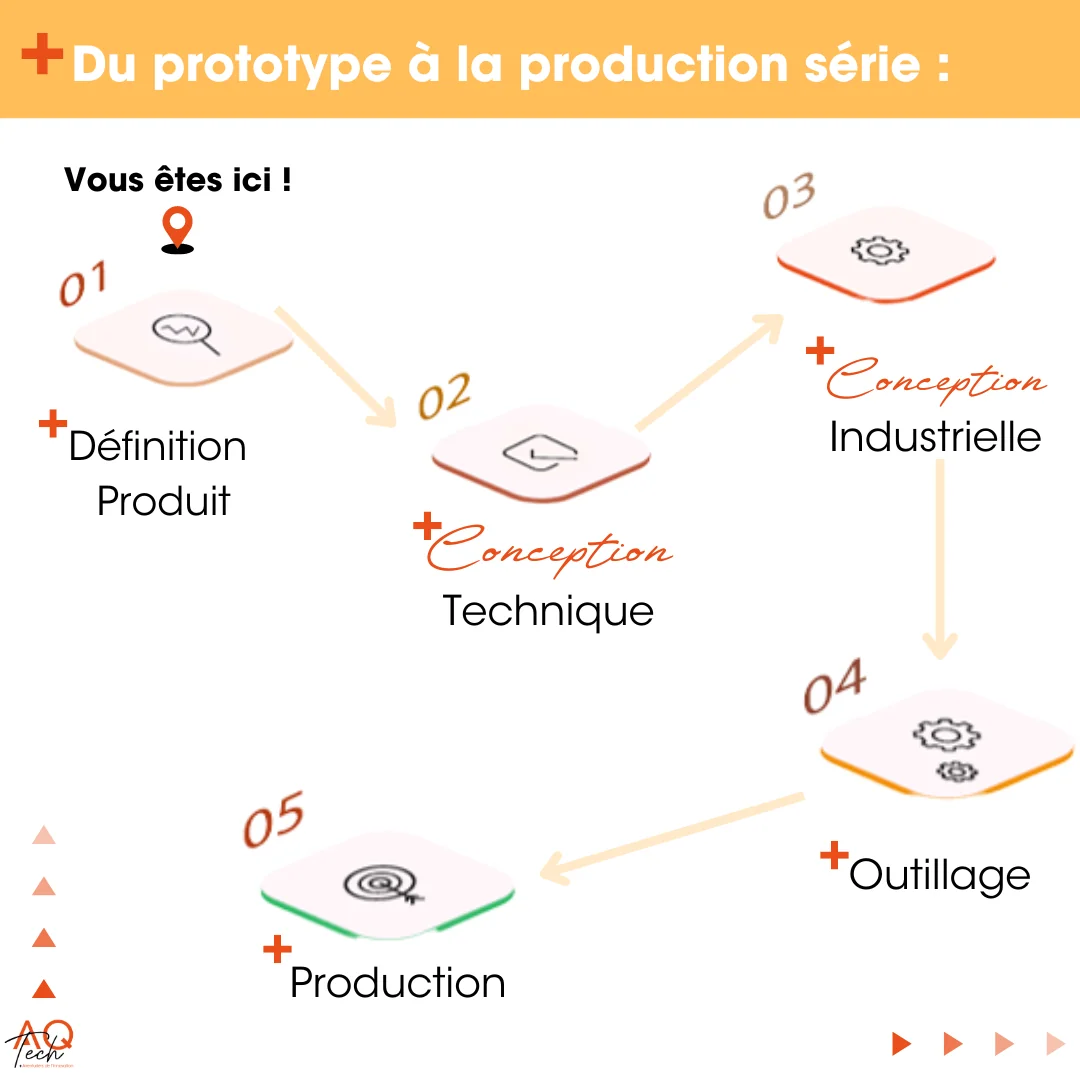
After budget, time is the second major challenge. Once the design is validated, you have to plan production. Yet the average lead time for a plastic mould is 3 months, on top of several weeks of fine-tuning.
For a typical wearable: 3 to 6 months between validated prototype and first pre-series parts. To reach a stable series-grade quality level: 12 to 18 months total (design + tooling + pre-series + ramp-up + corrections).
+ AQ-TIPS
- Don't underestimate the fine-tuning time of a wearable (textile-electronics interface = several iterations).
- Plan for 12 to 18 months before stabilised production.
- Improve gradually, prioritising critical issues.
3. Anticipate and think holistically
Industrialization isn't just about manufacturing. It also involves logistics, purchasing, storage, shipping and after-sales service. Anticipating these aspects from the design stage prevents bottlenecks.
On a connected device: secure the supply of critical electronic components (microcontrollers, specific sensors) — current shortages can freeze production for months. AQ-Tech helps clients identify these components and dual-source them or pick compatible alternatives from the design stage.
4. Test, learn and iterate
A perfect schedule doesn't exist. Every critical component can become a weak point if it's not secured.
Our advice: secure your strategic components from the start and leave slack in your schedules to absorb the unexpected. On the first pre-series, systematically allow for +30% to +50% extra time compared to theory.
+ AQ-TIPS
- Identify critical components (microcontroller, specific sensors, battery).
- Plan validated replacement parts.
- Leave breathing room in your schedule.
5. The keyword: continuous improvement
Industrialization isn't a sprint — it's a marathon. It is part of a continuous improvement approach, where each iteration brings progress in performance, quality and reliability.
At AQ-Tech, we support our clients along this path: adjust, correct, simplify, and make production ever smoother and more efficient — especially on small and medium technical batches where every detail matters.
In short
Every project is unique. Staying adaptive and agile is the key to a successful industrialization. AQ-Tech supports its clients from design to Made-in-France pre-series in Annecy, with a full service: design office, prototyping, industrialization and in-house manufacturing.