


Bringing in an external partner for outsourcing product development on a technical textile wearable lets you mobilise the best skills and accelerate time-to-market. This approach delivers a holistic technical vision and valuable agility during the critical phases of the project.
For a wearable combining mechanics, electronics and textile, outsourcing to a multidisciplinary engineering design house avoids the complex coordination between several specialised providers and guarantees the consistency of the final product. Here are the keys to outsourcing effectively.
1. Why outsource?
Outsourcing the development of an innovative product is not just a matter of convenience — it is a strategic decision. It allows you to:
- Access specific technical skills: embedded electronics, compact mechanics, technical textile, prototyping, industrialisation.
- Save time thanks to an already operational and tooled team.
- Reduce technical risk through the experience of a partner accustomed to the complete cycles of wearable products (wearables, airbags, connected PPE).
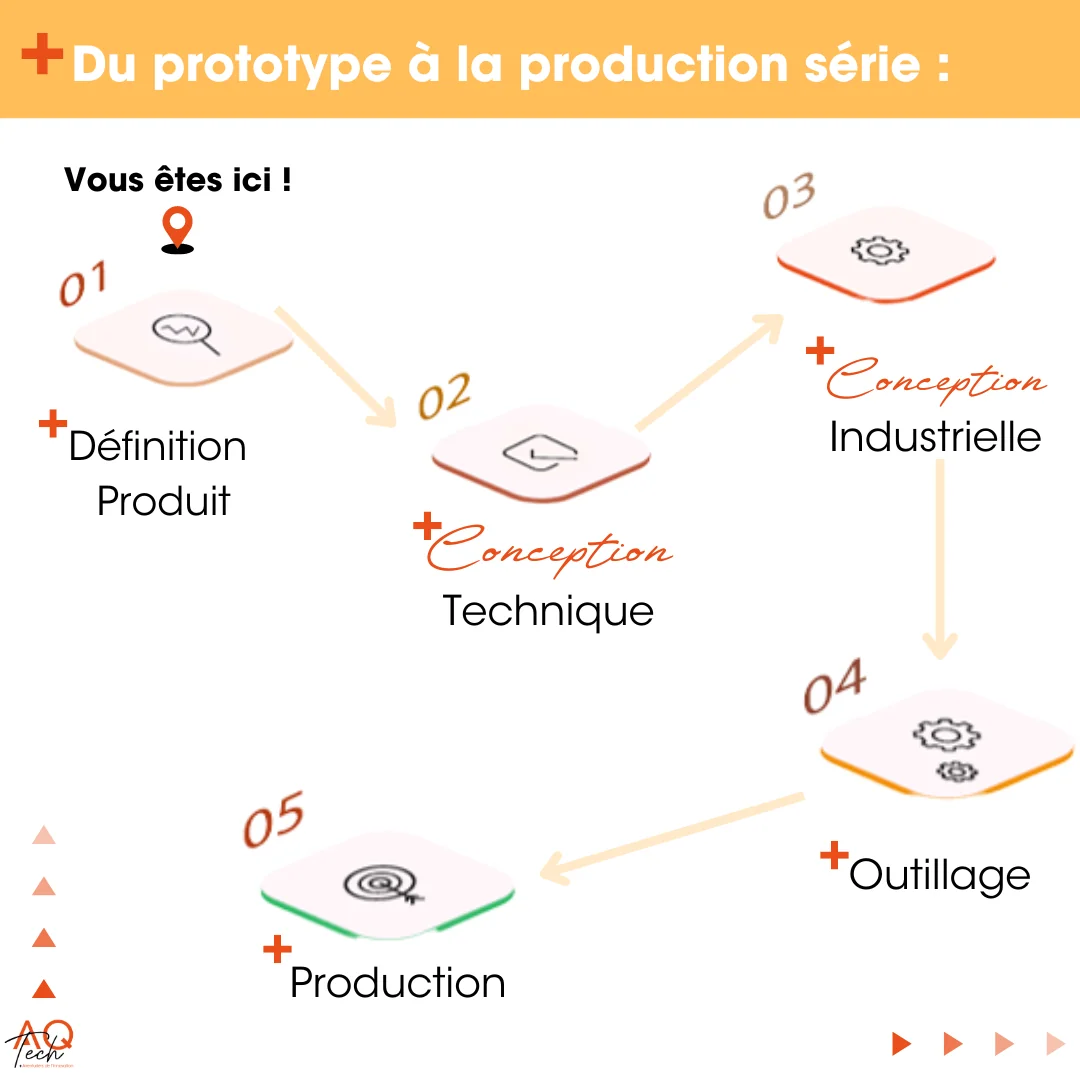
At AQ-Tech, we support our clients from the initial idea through to production launch, mastering the 3 key disciplines of active textiles under one roof. See our projects for concrete examples (Clinatec, Van Rysel, FreeJump, Optimergo and more).
2. Which type of partner should you choose?
Depending on the nature of the project, several options exist to outsource development partially or fully.
a. The freelancer
A flexible and fast solution for specific needs (CAD, electronics, design). Useful to complement an in-house team, but insufficient to manage a complete multi-technology product — coordinating three specialised freelancers is time-consuming and risky.
b. The industrial partner
An EMS (Electronics Manufacturing Service) or a plastics manufacturer is relevant if your product is derived from an existing one or if the goal is short-term series production. But these partners are production-oriented, with little R&D and limited multidisciplinarity. Risk of vendor lock-in and lack of agility for innovative iterations.
c. The engineering design house (textile / mechanical / electronics)
A multidisciplinary engineering design house is the most complete solution for innovative projects that combine several technologies. It brings the technical skills together under one roof and supports the whole product lifecycle: design, prototyping, industrialisation, pre-series manufacturing.
Key advantages for a wearable product:
- 360° expertise across mechanics, electronics and textile
- No outsourced technical sewing — everything is done in-house
- End-to-end methodological support
- One single team = one point of contact = one product vision
By choosing an engineering design house like AQ-Tech, you benefit from a single point of contact for the whole project and a cross-disciplinary technical vision — rare on the market and especially valuable for wearables and multi-technology products.
3. Essential points of attention
a. The billing model
Two main models:
- Time and materials: you pay for the number of days actually worked. The risk of overrun is on you.
- Fixed price (deliverable-based): the provider commits to a deliverable. The risk is borne by the partner, but the price includes a margin.
Hybrid solutions exist (fixed price per phase, time and materials on exploratory phases). The essential thing is to clearly frame deliverables and milestones from the start.
b. Project governance
Even when outsourced, a project remains yours. The partner should not work as a "black box". Set up regular tracking: steering meetings, written reports, iterative demos. Good coordination prevents delays and divergence of vision.
c. Intellectual property
Intellectual property must be defined in the contract. Specify:
- Who owns the results of the development (the client by default)
- Use of pre-existing patents or know-how of the engineering design house
- Exploitation rights over the developed technologies
- Responsibilities in case of blocking prior art
A clear contract plus a systematic NDA equals no dispute. AQ-Tech signs an NDA from the very first meeting, before any detailed technical exchange.
4. AQ-Tech, your active textile partner
At AQ-Tech, we are more than just an engineering design house. We act as our clients' outsourced innovation lab. Our team masters all the disciplines required to develop a complete active textile product:
- Compact mechanical design
- Embedded electronics and firmware
- Technical textile and soft integration
- In-house prototyping (500 m² Fab Lab)
- Industrialisation and pre-series manufacturing Made in France