




Knowing how to expand into adjacent markets can become a powerful growth lever for any industrial SME. Diversifying your offer, reaching new customers and broadening your scope strengthens resilience and secures long-term stability. But how do you get it right?
In active textiles and wearable innovation, AQ-Tech has supported several companies through this kind of pivot: a sports manufacturer moving into medical, an equestrian brand entering cycling, an electronics maker building its first wearable. Here are the 6 key takeaways from these technology transfer to new markets projects.
Summary
- 1. Innovate: think differently from day one
- 2. Control cost and timeline
- 3. Master multi-disciplinary engineering
- 4. Stay in control of your project
- 5. Don't miss the window
- 6. Integrate your partners and aim for full ownership
1. Innovate: think differently from day one
Innovation is not just a brilliant idea or a brand-new technology. It is, above all, about solving a real problem in a simple, relevant way. Too often, companies start from a technical solution before validating an actual user need.
In active textiles, start from the gesture, comfort and context of use: which movement disturbs sensor wear? Which body area sweats most and limits ECG measurement? What battery life is acceptable for the end user? These answers drive everything else.
At AQ-Tech, this logic guides our wearable product development projects. We help our clients turn ideas into concrete solutions through ideation workshops, prototyping and rapid validation.
2. Control cost and timeline
Time and budget are the two parameters that can make or break a diversification project. Entering a new market means moving fast without skipping steps, by progressively validating the critical assumptions.
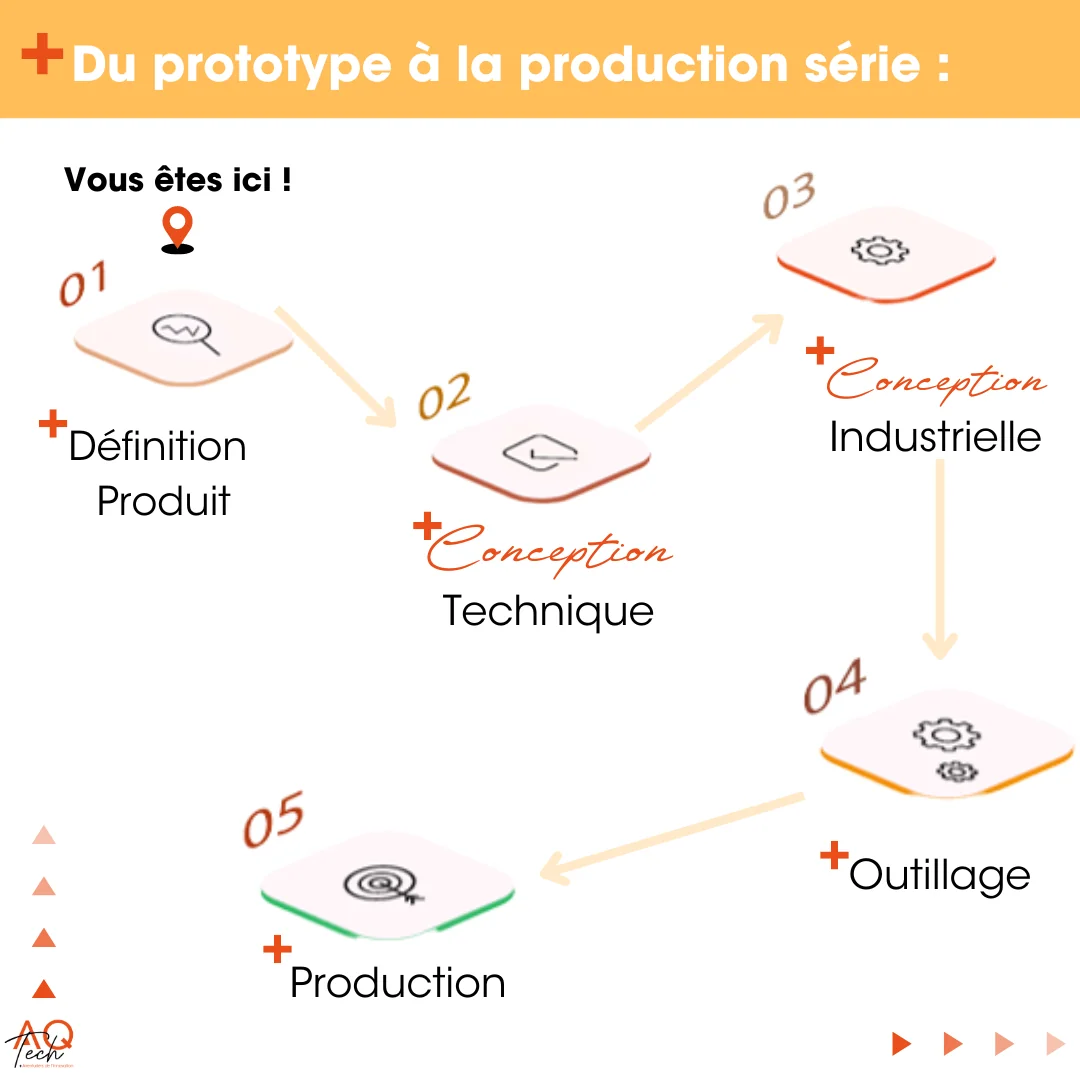
How? By splitting the project into short, measurable stages: pre-study, prototype, functional validation, pilot run. Each phase limits risk and lets you adjust the trajectory before committing to large expenses.
Methods such as rapid prototyping — 3D printing, vacuum casting, HF welding, modular PCBs — drastically speed up iteration cycles while keeping cost under control.
3. Master multi-disciplinary engineering
An idea is only worth what its industrialisation is worth. On an active textile product, this means mastering three disciplines at the same time: compact mechanical engineering, embedded electronics, technical textile engineering.
The gap between a working prototype and an industrialisable product is huge. A prototype can prove an idea, but only well-controlled multi-tech design guarantees reliability, washability, maintenance and serial reproducibility.
4. Stay in control: stay involved in the process
Entrusting a project to external partners must never mean losing control. Stay actively involved at every step: specification, technical choices, prototype validation and production follow-up.
- Work transparently with your partners.
- Challenge the technical proposals.
- Make sure key decisions stay aligned with your product vision.
At AQ-Tech, transparency is part of our DNA. We keep you involved at every step so you can take over or extend the project confidently in the future — and your IP stays yours.
5. Don't miss the window: move fast, but with method
In a competitive landscape, timing is critical. You have to be fast to seize opportunities, yet rigorous to avoid costly mistakes. The key: an agile, flexible process that lets you adapt the product to market feedback quickly.
A progressive de-risking approach removes the biggest unknowns early — especially useful on wearables where textile-electronics integration can block you late in the cycle.
6. Integrate your partners: aim for full ownership
Winning a new market also relies on the strength of your ecosystem. Choose reliable partners able to challenge your ideas. A trust-based relationship and fluid communication are essential.
For technical textile products, favour a single partner covering all three disciplines (mechanics, electronics, textile) — coordinating three separate specialists systematically generates information loss at the interfaces.
Conclusion
To successfully expand into adjacent markets in active textiles, you have to think differently: start from the real need, stay agile, surround yourself with a multi-disciplinary partner and keep the global product vision. Innovation is not a sudden disruption — it is a chain of smart, coordinated decisions.
AQ-Tech supports its clients across the three families of technical textile applications: smart textiles, wearable inflatable systems, functional textiles.