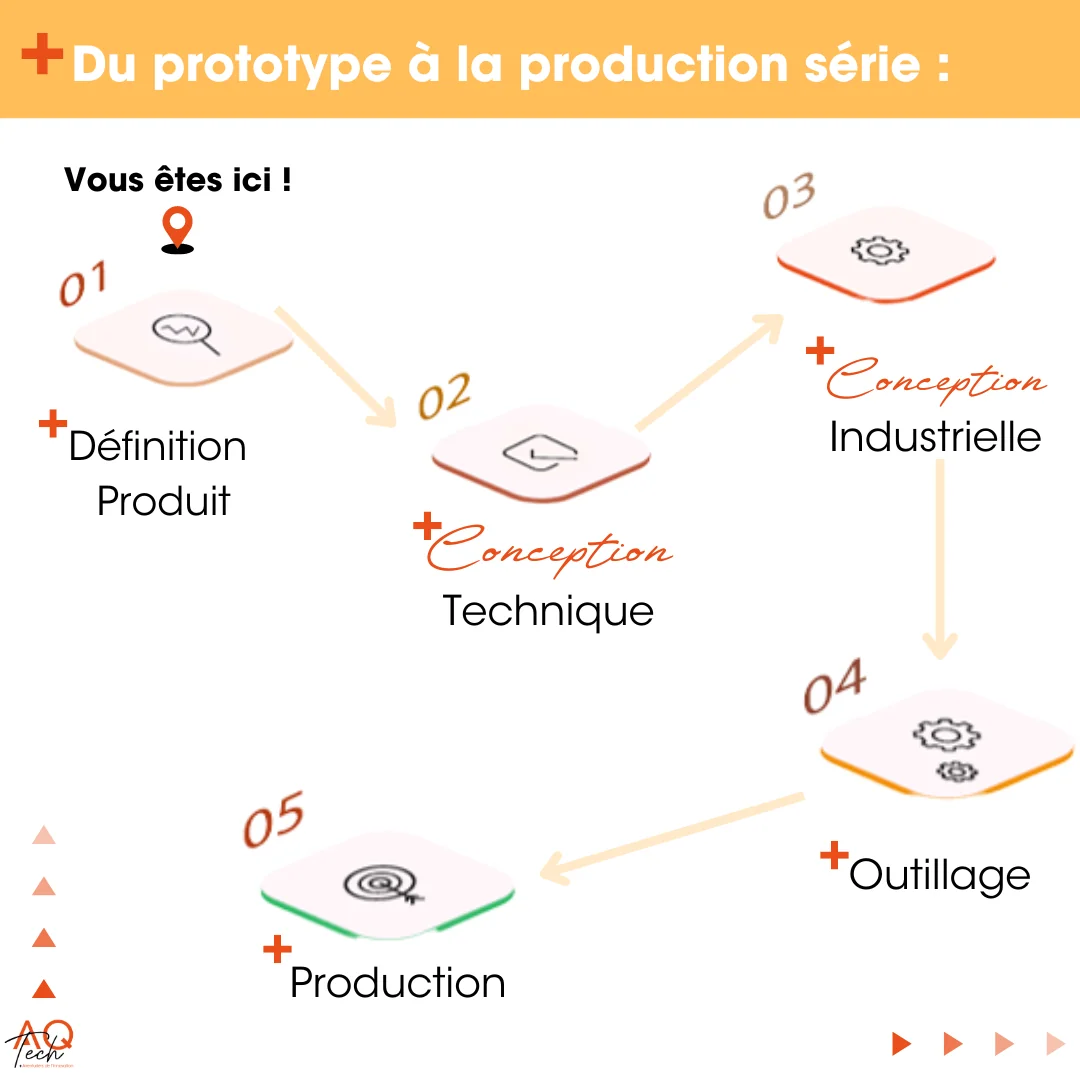



You have an innovative product idea and a well-defined specification? The next step seems obvious: prototype your concept to kick off industrialisation. Yet, before that exciting phase, there is an often overlooked but essential step: the product architecture study.
For multi-technology products — wearables, worn airbags, soft exoskeletons — this stage is even more decisive: combining mechanics + electronics + textile multiplies the interactions to anticipate, and poor architecture is expensive in iterations.
1. What is a product architecture study?
The architecture study, or pre-technical study, is the first phase of product development. At AQ-Tech, it serves to analyse functions, constraints and technology choices in order to define the best design strategy.
Concretely, it consists in identifying every function of the product and translating them into viable technical solutions. The goal is to compare these solutions on relevance, cost, reliability and manufacturability.
Example on a connected garment: the study will determine the communication technology (BLE, LoRa, Wi-Fi), the type of sensor (textile ECG, IMU, EMG), battery autonomy, the textile-to-electronics connection method (snap, HF welding, overmoulding), the targeted washability and the ergonomic placement of the module. Each choice is weighed on cost, reliability, footprint and availability.
This phase produces a reference document that guides engineers through prototype design and justifies every technical choice.
2. Key stages of a multi-technology architecture study
The starting point is the specification. Even if it seems complete, it must be reformulated and enriched by the engineering office to ensure shared understanding.
a. Define the product functions
The product is not limited to its normal operation. Every scenario must be considered:
- What happens when the battery is low?
- How does the product react if a sensor fails?
- Should it support remote updates (OTA)?
- How does it behave during washing / drying?
- How does it interact with the wearer during extreme movement?
b. Identify the technical constraints of the worn product
Once the functions are defined, examine the physical and environmental constraints:
- Washability: how many cycles, at what temperature?
- Sealing (IPX), UV resistance, sweat and shock resistance?
- Wearing comfort: weight, footprint of the electronic module
- Dismountability: electronics separable from the textile for recycling?
c. Factor in market and certification constraints
A product must be technically achievable but also economically viable:
- What is the target manufacturing cost?
- For what volume (10–100 pre-series, 1k–100k series)?
- Which certifications (CE PPE, MDR class I/IIa, FCC, RED)?
The architecture study thus covers the full product life cycle. This work often surfaces unanticipated issues and lets you adjust the specification before moving to detailed design.
3. Multi-disciplinary technical analysis
Each function is studied to identify the technical solutions on the table:
- Which technology meets the function (BLE, LoRa, Wi-Fi, NFC, wired)?
- Which manufacturing process (injection, 3D printing, HF welding, sewing)?
- Which mechanical assembly offers the best trade-off between robustness, cost and repairability?
- Which firmware architecture (sleep mode, OTA, embedded processing)?
Each option is evaluated against precise criteria: complexity, production cost, footprint, weight, power consumption, washability. Solutions are compared and only the most relevant ones are kept.
4. Keys to a successful architecture study
Two conditions are essential:
- Have a complete view of the product: functions, technical constraints, uses, maintenance, recycling, manufacturing, logistics.
- De-risk every function: the earlier a risk is identified, the cheaper it is to fix.
On a multi-technology product, it is crucial to mobilise the 3 expertises at the same time from this stage onward: a mechanical engineer, an electronics engineer, a textile technician. A decision made in silo systematically triggers a costly iteration loop — this is what sets our multidisciplinary engineering office approach apart.
5. An essential collaboration
A successful architecture study rests on close collaboration between your team and the engineering office. You know your market and your needs; we bring our technical expertise (mechanics, electronics, technical textile) and our overall view of product life cycles.
A well-run architecture study is not lost time, but a major gain over the entire development.