


Hardware product development is a complex process, often unfamiliar to those who have never gone through a first development cycle. Moving from an idea to an industrialised product demands rigour, method and close collaboration across several disciplines: mechanics, embedded electronics, firmware, design and production.
For wearable hardware products — smart garments, connected PPE, soft medical devices — the constraints are even tougher: battery life, washability, biocompatibility, CE/MDR certification. In this article, AQ-Tech opens the doors on a successful embedded hardware development.
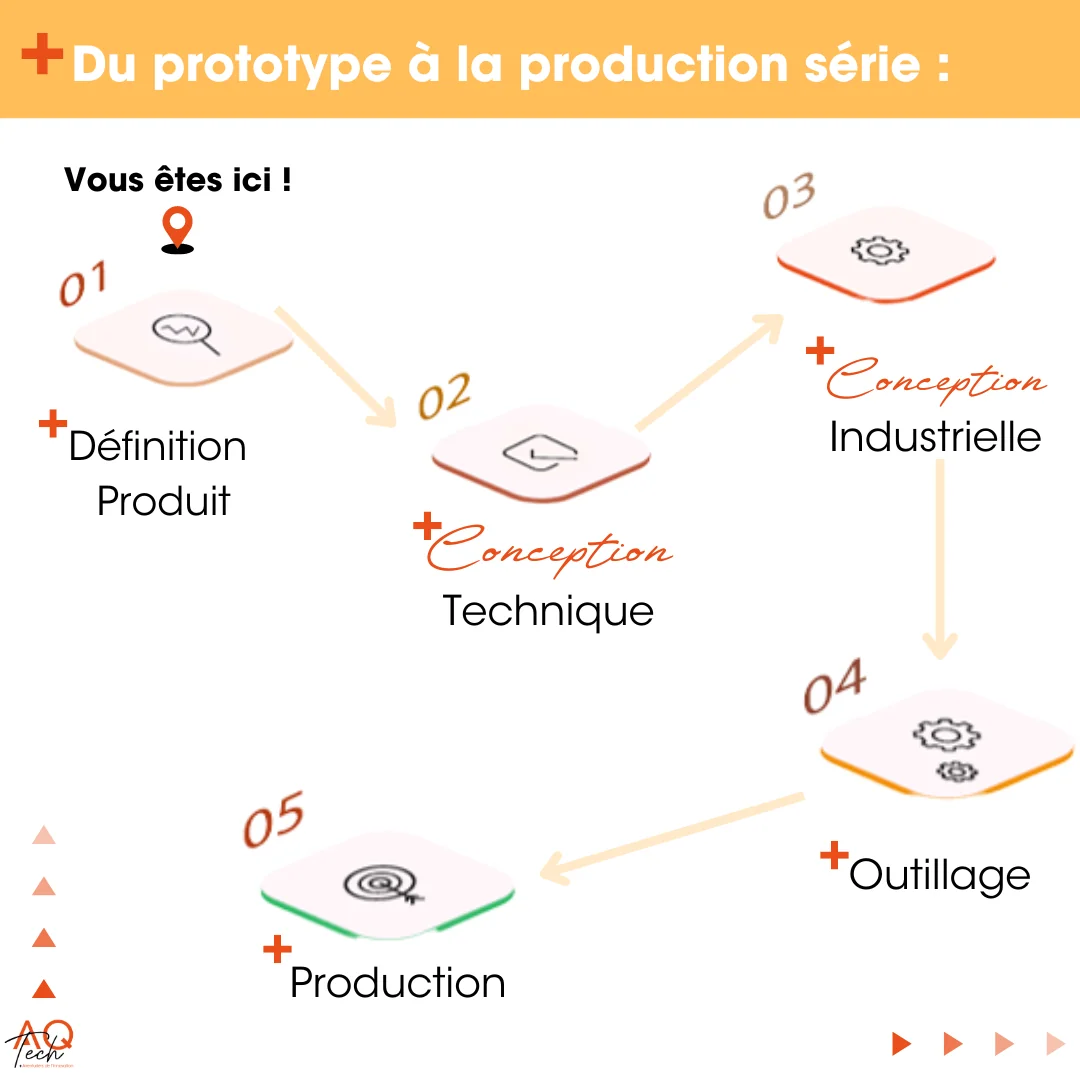
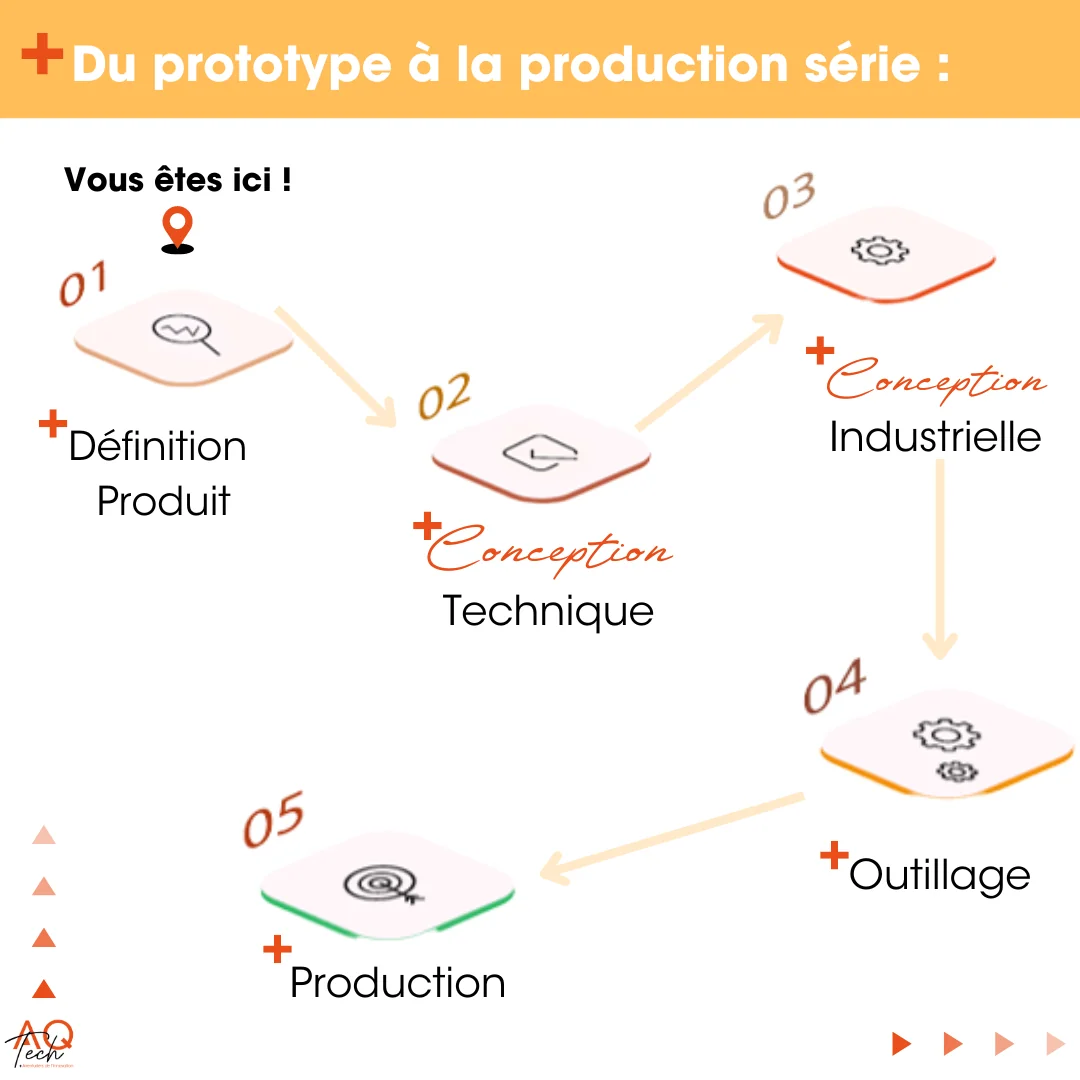
1. A structured process, step by step
You don't go from an idea to a manufacturing-ready product without intermediate stages. Each phase must validate a specific aspect of the product — technical, ergonomic, aesthetic or industrial — before moving on to the next.
The principle: validate, test, iterate at every stage without over-investing too early. Each phase has its own expected level of maturity and finish.
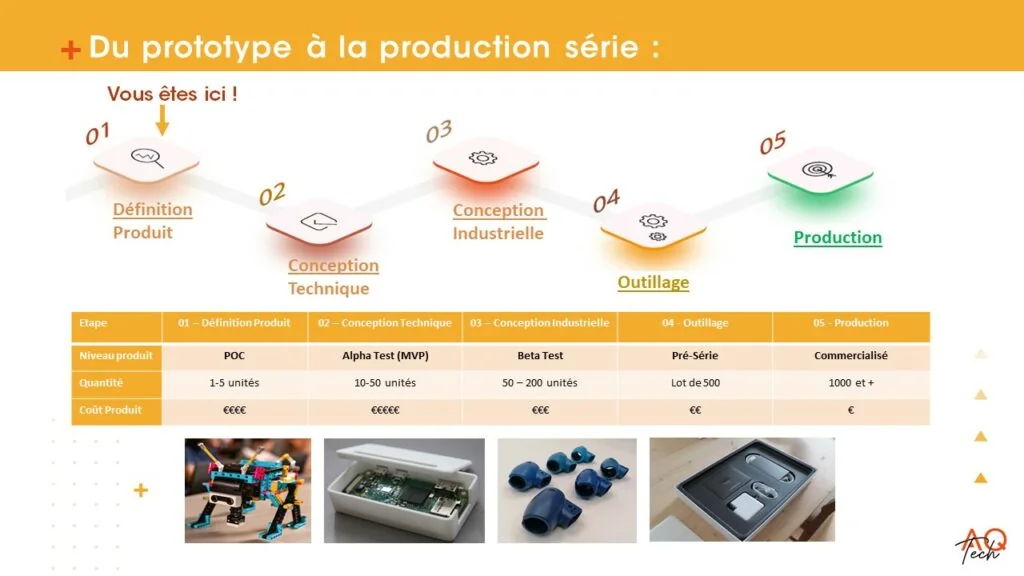
2. Product definition: setting the foundations
Everything starts with the product definition phase. The idea must be translated into a clear, testable concept:
- Technical feasibility (sensors, battery life, connectivity)
- Design and wearable ergonomics
- User experience
- Regulatory constraints (CE PPE, MDR, RED) and environmental requirements
For wearable hardware, the first prototypes can be simple Arduino or Raspberry Pi boards with off-the-shelf sensors, taped onto a mannequin or volunteer. The key is to test early, confront the idea with future users and adjust.
3. Technical design: validating the building blocks
The technical design phase develops and tests the building blocks that will make up the final product: sensors (ECG, EMG, IMU, pressure), low-power microcontrollers (nRF52, STM32, ESP32), connectivity (BLE, LoRa, Wi-Fi), power management and interfaces.
The focus is on technical performance, not yet on manufacturing or aesthetics. Several optimisation loops are usually required before reaching a stable version. Close collaboration between electronics and firmware is essential to guarantee overall performance.
For a wearable, this is also the stage where you choose the textile-electronics integration strategy: removable pocket module, HF welding, conductive yarns, silicone overmoulding.
4. Industrial design: preparing for manufacturing
Once the technology choices are frozen, the industrial design phase begins. Every detail is optimised: clips, tolerances, fasteners, assembly, materials, cabling, mechanical-textile integration.
The goal: make the design robust and reduce production costs. This stage requires close collaboration with industrial subcontractors (mould makers, EMS providers, textile workshops) to adapt the product to their processes.
This phase typically ends with beta prototypes: the product is complete in terms of design and materials but not yet manufactured on an industrial line. This is also when the certification phase (CE, MDR, FCC) starts.
5. Tooling and fine-tuning
Time to build the production tooling: plastic injection moulds, assembly jigs, quality control fixtures, final textile patterns, HF welding tools. This equipment takes several weeks to several months to fine-tune.
Each tool is tested, adjusted and validated using real samples. This critical stage delivers a stable process before moving into production.
6. Production and industrialisation
With tooling validated, the product moves into series production. The ramp-up is done in progressive batches to tune the line, the quality level and the cadence.
A quality protocol is defined to track production: monitoring of critical dimensions, functional tests, washability validation by sampling, traceability, batch release. AQ-Tech manufactures pre-series in house (10 to 500 units) at its Annecy workshop before transferring larger volumes to our European partners.
7. Conclusion: from idea to reality
Every project follows its own path: some need several technical iterations, others move faster depending on their complexity. Whatever the trajectory, the key to success is to respect the stages and to test at every phase.
At AQ-Tech, we support our clients from concept to production, with a holistic approach: mechanics, embedded electronics and firmware, technical textile for wearable products.