


Industry, healthcare, sports, defense or wellbeing: whatever the sector, the success of an innovative wearable product depends on a well-controlled development cycle. At AQ-Tech, we support our clients from the very first idea through to series production of wearables, airbags, exoskeletons and medical devices. The goal: anticipate technical and industrial constraints while keeping the agility needed to focus on added value.
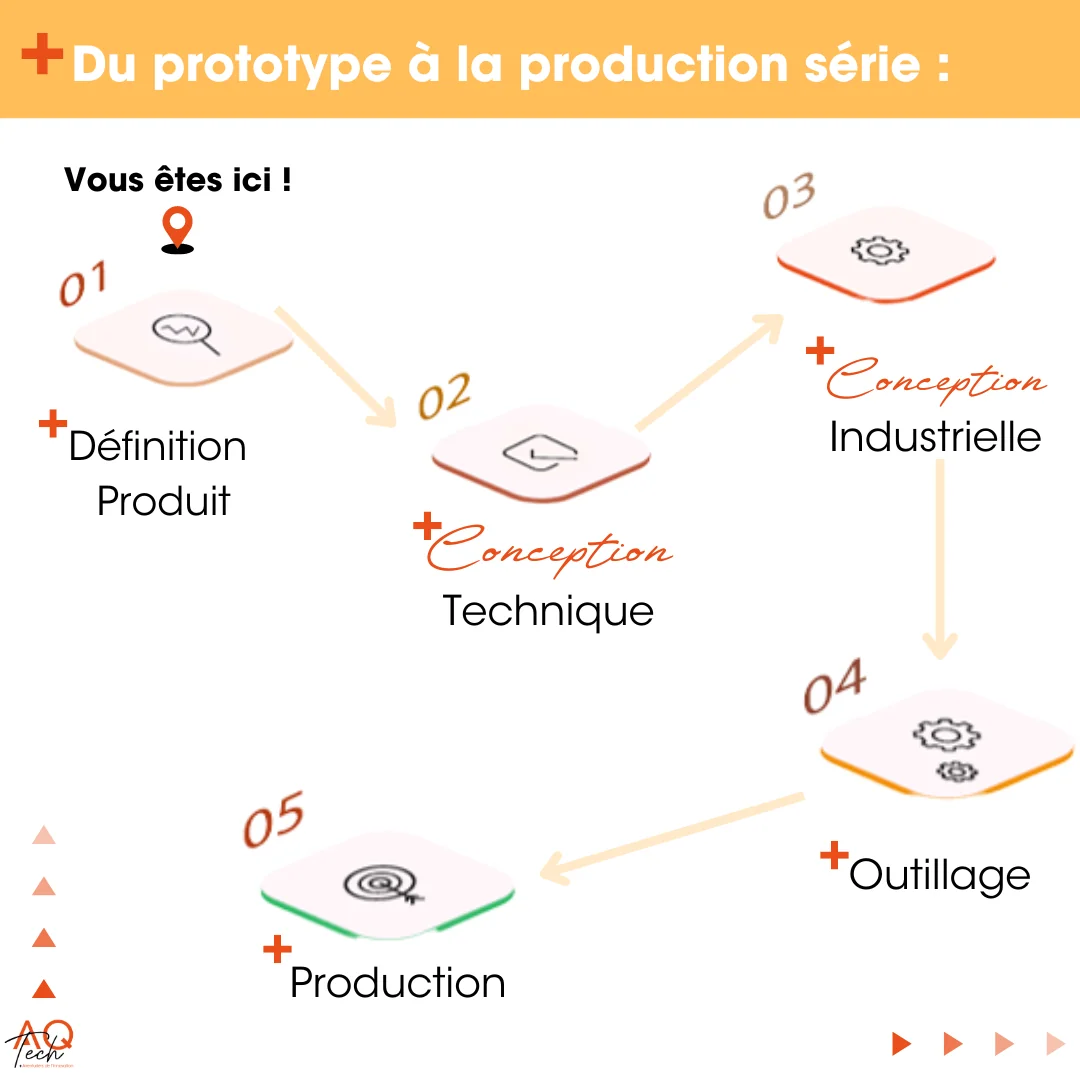
Here are the 6 main product development and industrialization steps that structure the journey from concept to series, illustrated by the multi-technology projects (mechanics + electronics + textiles) we deliver every day through our engineering services.
1. Feasibility study: setting the project foundations
The feasibility study validates the technical, financial and industrial viability of the product. It is an essential scoping phase: choice of technologies, ergonomic design for a wearable product, manufacturing processes (sewing, HF welding, plastic injection, PCB), target costs, regulatory constraints (CE PPE, MDR, REACH).
For a wearable, this stage also includes critical choices: sensor/actuator architecture, target battery life, required wash cycles, biocompatibility. See for example our Clinatec project (class IIa medical device) or FreeJump (CE PPE airbag vest).
2. Prototyping: bringing the idea to life
Time for creativity. Prototyping turns sketches into tangible objects. This is where the product takes shape — we test, adjust and iterate. The phase validates the proof of concept and surfaces the first technical roadblocks.
For wearable products, we adopt an iterative multidisciplinary approach: 3D printing for rigid parts, HF welding for inflatable chambers, technical sewing + textile interconnects for the garment carrier, PCB boards for embedded electronics. Several versions are built within a few weeks to validate real-world use.
Our advice: from the prototyping phase, think about the full product lifecycle — washability, recharging, maintenance, recycling, end-of-life of the battery. Anticipating these aspects saves significant time during industrialization.
3. Industrialization: from prototype to series
The objective: move from a functional prototype to repeatable, stable and profitable production. This is often the most demanding phase, as it requires optimizing every detail: mechanical design, electronics integration, textile assembly, tolerances, processes.
- Anticipate the full lifecycle: manufacturing, quality control, packaging, transport, after-sales, recycling.
- Surround yourself with the right industrial partners: plastic injection, PCB manufacturing, technical textile workshop, final assembly. AQ-Tech works with a network of European partners to guarantee quality, responsiveness and cost control.
- Document the processes: bills of materials, assembly routings, quality control plans.
The classic trio goal / cost / lead time remains universal. Success comes from technical rigor, communication and collaborative management.
4. Pre-series and validation
Once tooling is finished and components received, it is time for industrial fine-tuning. The first units — a pre-series of 10 to 100 pieces — let us test the entire process: machine setup, tolerances, assembly quality, product compliance, washability, certifications.
Avoid jumping straight into full-scale production. An internal pre-series in our Annecy workshops identifies critical points, adjusts parameters and de-risks the supply chain before ramping up volumes.
5. Industrial transfer
Once production is stabilized, the industrial transfer step consists of taking back control of the process and key operations: quality checks, assembly, logistics. It is a strategic phase, because it documents, standardizes and enables autonomous production management — at your site or with an industrial partner.
AQ-Tech supports its clients through this skills ramp-up. Mastering production means guaranteeing the quality and long-term viability of the product over time.
6. Production and series life
Your product is ready to be manufactured at scale. But production is a living mechanism: sourcing, inventory, quality returns, supply chain management. Current tensions on electronic components are a reminder of how crucial production management has become.
AQ-Tech runs series production follow-up and associated logistics for several clients, ensuring smooth supply and continuous quality control.
Conclusion
Designing and industrializing an innovative wearable product means making the right choices at the right time. The process is iterative: back-and-forth, adjustments and challenges are essential to reach excellence — particularly when combining mechanics, electronics and textiles in the same product.
At AQ-Tech, we put this method to work for your projects: smart textiles, wearable inflatable systems or functional textiles, from concept to series.