


Welcome to the fascinating world of the Internet of Things (IoT). Choosing the right connectivity for your connected product is a decisive step of the development process. At AQ-Tech, we approach this decision with pragmatism and method, because picking the right network determines the performance, reliability and economic viability of your product.
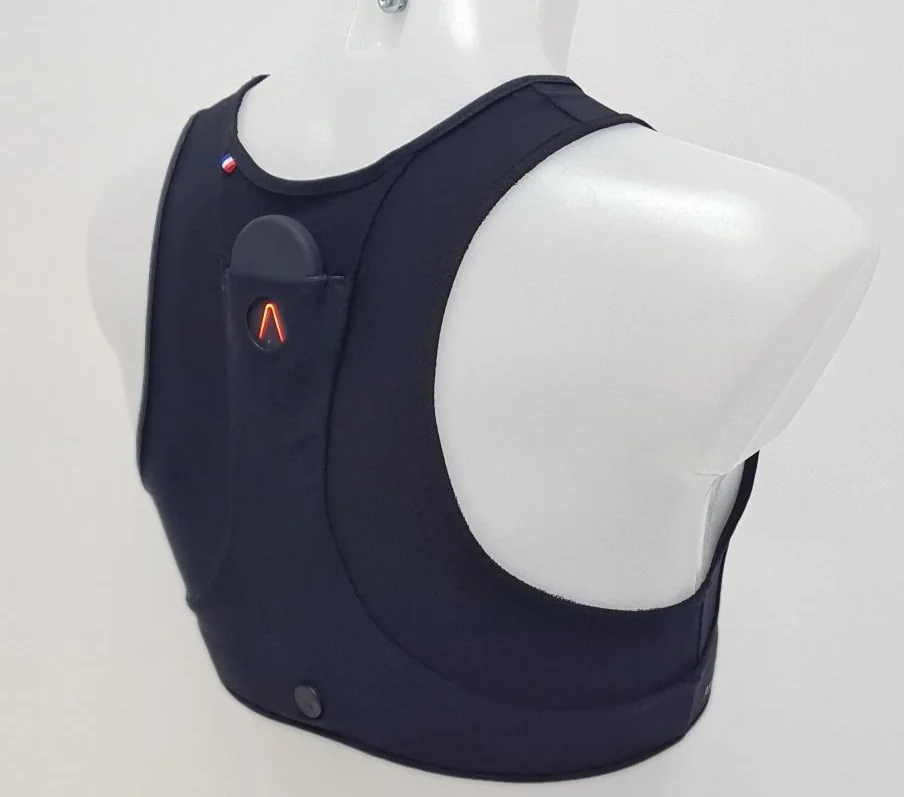
For a connected garment or a wearable, the choice of connectivity carries even more weight: battery life is constrained (limited space, comfortable wear), latency drives user experience (haptic feedback, alerts), and regulations (CE, RED) impose specific constraints on worn objects. Here are the five key criteria we apply on smart textile projects.
1. Range: matching the network to wearable use
The first criterion is the communication range required by your application. It directly drives the type of network to use:
- Short-range networks: Bluetooth Low Energy (BLE), NFC, Zigbee - ideal for wearables connected to a smartphone or a relay station (sports garment, home medical device).
- Long-range low-throughput networks: LoRa, Sigfox, NB-IoT, LTE-M - suited to industrial connected PPE or autonomous products in wide-area environments.
- Cellular networks: 4G/5G - for wearables that must communicate without depending on a smartphone (lone-worker alert, autonomous medical monitoring).
On 80% of the smart textile projects we develop, BLE remains the standard - it combines sufficient throughput, low power consumption and a mature mobile ecosystem.
2. Transmission capacity: matching throughput to signals
The volume of data to transmit directly influences the choice of protocol. Some projects require high data rates (video, audio, telemetry), while others only send a few bytes per day (environmental sensors).
For a wearable:
- Continuous ECG (250 Hz): ~2 kbps raw, manageable over BLE after embedded filtering
- Multi-point EMG: 4-16 kbps depending on the number of electrodes, BLE or Wi-Fi recommended
- 9-axis IMU: ~1-2 kbps during intense motion
- Respiratory pressure: ~100 bps, compatible with LoRa for long-term monitoring
At AQ-Tech, our engineers systematically assess the performance / battery life / cost ratio from the prototyping stage onward.
3. Reliability and quality of service: critical for medical and safety
Reliability is essential, especially in mission-critical applications: medical devices (patient monitoring, fall alert), connected PPE (lone-worker fall detection), wearable airbags (assisted deployment).
Quality of service must guarantee:
- Continuous transmission with no loss of critical data
- Controlled latency (< 100 ms for haptic feedback, < 1 s for alerts)
- Strong security (BLE 5+ encryption, MQTT TLS) for health data
4. Power consumption: the number one challenge for wearables
Power consumption is a major challenge for wearables - the battery is physically limited (size, weight, washability) and users will not accept charging every day.
The best practices we apply:
- Embedded pre-processing: filter the signal on the module before transmission
- Buffering: send packets every X seconds rather than streaming continuously
- BLE advertising mode for ultra-low-power sensors
- Wake-on-event: transmit only when an event occurs
On a properly optimized EMG T-shirt, we typically achieve 8 to 12 hours of continuous use on a CR2032 coin cell or a 100 mAh flat LiPo.
5. Total cost: anticipating economic viability
The final criterion is total cost: module + development effort + network subscription + maintenance.
On consumer wearables, BLE almost always wins: no subscription, modules under EUR 2, mature mobile ecosystem. On industrial or autonomous medical wearables, LoRa or NB-IoT can be relevant despite the subscription (typically EUR 1-5 / month / device) - provided you carefully size the data volume.
Conclusion
Choosing the right IoT connectivity means finding the perfect balance between performance, reliability, battery life and cost - and on a connected garment, that choice is made under stricter constraints (space, washability, certifications) than on a classic IoT object.
AQ-Tech supports its clients across the full cycle: technology selection, electronics & firmware design, prototyping, real-world network performance validation, and industrialization.