


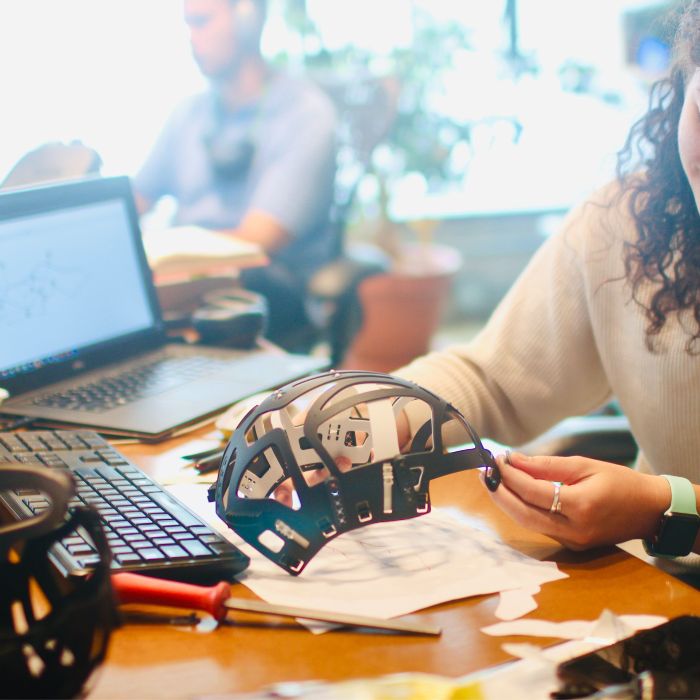
Iterative Prototyping: The Key to a Successful Product
At AQ-Tech, our mission is to transform ideas into tangible, high-performing products. We bridge design, engineering, and industrialization to turn innovation into reality — efficiently, quickly, and reliably.
After designing hundreds of prototypes for startups, SMEs, and industrial clients, we have refined an approach that minimizes risks, shortens lead times, and maximizes technical and market validation. The secret? Iterative prototyping — a method that builds confidence and knowledge at every stage of development.
1. Define your product… but don’t overdefine it
Before you start designing, clarify your vision. Identify what the product must do, who will use it, how it will be used, and what will make it stand out. But avoid writing a 50-page specification at this stage. Early overdefinition often locks teams into rigid paths that slow innovation.
Focus first on the core functions that deliver real value to the user. Secondary features — aesthetic options, sensors, connectivity — can be integrated later, once the fundamentals are validated. Too many projects fail because they try to deliver everything at once, losing focus and usability.
A design thinking phase can be invaluable here: mapping user needs, exploring use cases, and prioritizing real pain points. At AQ-Tech, we often collaborate with specialized design agencies to help our clients take this critical step. If you need guidance, our team can connect you with the right partners.
2. Validate your assumptions early — and often
One of the biggest traps in product development is believing that you know what users want. The truth is that assumptions, even informed ones, are rarely accurate without testing.
The best advice we can give any innovator is: test, test, and test again — as early as possible. Don’t wait for a perfect prototype. Test an early mock-up, a functional model, or even a 3D-printed version. Real feedback from real users is far more valuable than internal opinions.
Early testing helps you identify whether the product truly solves a problem worth paying for. It reveals usability issues, unmet expectations, and unexpected opportunities. Even if your prototype is not perfect — perhaps heavy, unpolished, or lacking details — genuine users will focus on the value it brings, not its flaws.
Your goal should always be to develop the product with your users, not just for them. Co-creation accelerates validation and ensures your final product resonates with its market.
3. Iteration: the real key to progress
Iterative prototyping means breaking your development process into cycles of experimentation. Each prototype answers a specific question: Does it work? Is it comfortable? Does it meet performance goals? Each iteration is a learning phase that de-risks the next step.
We define a testing roadmap for every prototype. Once built, it undergoes functional validation — both in-house and with selected users. We document every finding, then adapt the design accordingly. This cycle continues until the product reaches its target performance and usability levels.
Two possible outcomes exist for every iteration:
- The product fails to meet expectations: in this case, we rework the core of the innovation, adjust the concept, and correct early mistakes before scaling.
- The product meets or exceeds user needs: we can then enhance details, add secondary functions, and prepare for pre-series prototyping.
Iteration not only improves performance — it also saves time and money. By validating one layer at a time, you avoid discovering major design flaws late in the process, when they are far more costly to fix.
AQ-TIPS
- Identify and prioritize the must-have features of your product.
- Test as soon as possible, regardless of the prototype’s appearance.
- Collect feedback from users outside your development team.
- Iterate progressively, validating one functionality level per step.
4. From prototype to industrial reality
Each iteration brings your concept closer to its final form. But iterative prototyping also prepares you for industrialization — by revealing manufacturing constraints, assembly limitations, and cost drivers early on. When done right, your last prototype becomes nearly identical to the version that will enter production.
Our multidisciplinary approach at AQ-Tech ensures that the transition from lab prototype to factory-ready product is seamless. Our engineers combine mechanical, electronic, and textile expertise to align creativity with manufacturability.
Conclusion
Skipping iterations might seem like a way to save time, but in reality, it leads to rework, delays, and frustration. Embracing iterative prototyping is the best investment you can make for your project’s success. It creates clarity, builds confidence, and ensures that your final product truly meets user expectations.
Discover how our team supports clients throughout the prototyping and innovation journey, or contact us to discuss your next product idea.